The NBOME advances understanding of osteopathic medical education, COMLEX-USA, and the role of osteopathic physicians across the continuum of medical education and practice. Through advocacy, education, research, and stakeholder engagement, we support equitable opportunities for DO students and residents and promote informed, appropriate use of osteopathic credentials.
Use this page to learn more about NBOME advocacy efforts, access resources that support accurate understanding of COMLEX-USA, and share concerns about barriers that may affect fair consideration of DO applicants. Get involved by sharing concerns, using NBOME educational resources in advising and residency selection conversations, and helping to promote accurate understanding of osteopathic medical education among residency programs, specialty organizations, and other stakeholders.
Why Advocacy Matters
Osteopathic medical students and residents contribute meaningfully across every specialty and practice setting, yet some learners continue to encounter inconsistent understanding of osteopathic medical education, COMLEX-USA, and the credentials that support osteopathic licensure. Advocacy helps address these gaps by providing accurate information, encouraging fair and transparent review practices, and supporting educational environments in which DO applicants are evaluated on the full range of their qualifications.
Understanding Osteopathic Medicine
Doctors of osteopathic medicine (DOs) are fully licensed physicians in the United States and other countries. Their patient care approach aligns with their distinctive training in comprehensive, evidence-based medical care, summarized as the interconnected body-mind-spirit approach to finding, restoring, and maintaining health.
The Tenets of Osteopathic Medicine express the underlying philosophy of osteopathic medicine:
The body is a unit; the person is a unit of body, mind, and spirit.
The body is capable of self-regulation, self-healing, and health maintenance.
Structure and function are reciprocally interrelated.
Rational treatment is based upon an understanding of the basic principles of body unity, self-regulation and the interrelationship of structure and function.
Many physicians who choose osteopathic medicine strongly identify with its distinctive philosophy and whole-person approach to patient care. Since 1934, the NBOME has provided assessment tools designed to evaluate the competencies required for osteopathic medical licensure. These assessments align with the education, training, and practice of osteopathic physicians.
Osteopathic medicine is grounded in a distinctive philosophy that emphasizes whole-person, patient-centered care and the interrelationship of structure and function. Many physicians who choose osteopathic medicine strongly identify with this approach and carry it forward in their clinical training and practice.
Understanding Osteopathic Assessment
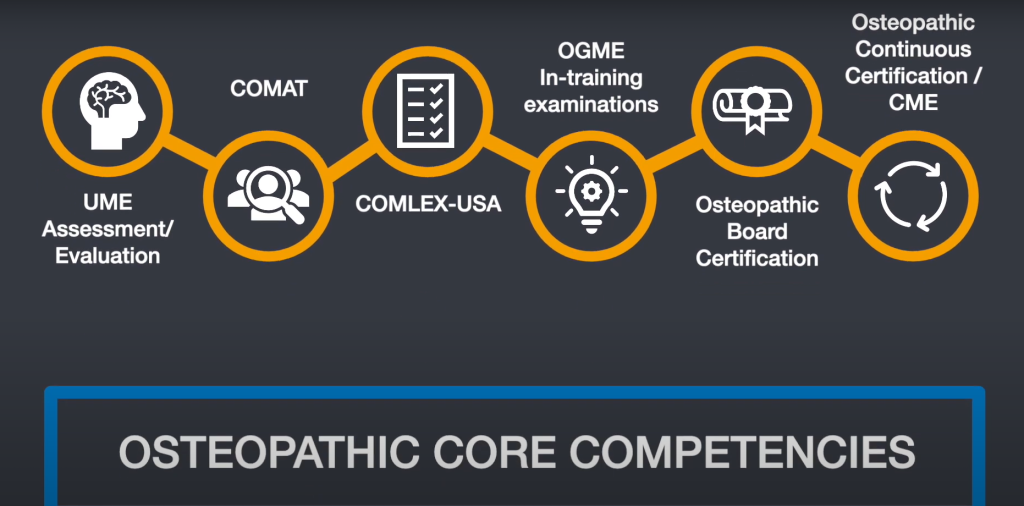
The COMLEX-USA examination series is the licensure pathway for osteopathic physicians and is accepted by all state medical licensing authorities in the United States. The examination program is designed to assess competencies required for safe and effective osteopathic medical practice, including biomedical and clinical science knowledge, osteopathic principles and practice, clinical decision-making, and readiness for unsupervised care.
Program directors, faculty, advisors, and other stakeholders can use NBOME resources to better understand COMLEX-USA score interpretation, examination blueprints, percentile information, research, and the role of osteopathic assessment in residency selection and medical licensure.
Use the resources below to support informed conversations with residency programs, faculty advisors, and others involved in evaluating DO applicants.
Resources
Future of Clinical Skills Assessment
Beginning with the Class of 2029, osteopathic medical students will demonstrate clinical skills competency through one of two pathways: the Core Competency Capstone for DOs (C3DO) or Comprehensive Competency Verification (CCV). These pathways are intended to support assessment of core osteopathic clinical skills through direct observation and will satisfy the clinical skills eligibility requirement for COMLEX-USA Level 3.
Click “Learn More” to understand how future graduates will demonstrate clinical skills competency as part of the COMLEX-USA pathway with the C3DO and CCV updates.
Why We Advocate
The NBOME advocates for fair, transparent, and holistic review processes in undergraduate and graduate medical education. Our advocacy efforts focus on increasing awareness of osteopathic medical education, promoting appropriate use and acceptance of COMLEX-USA, reducing unnecessary barriers for DO students and residents, and supporting equitable opportunities throughout the transition from medical school to residency and beyond.
How We Advocate
The NBOME collaborates with organizations across the house of medicine to remove barriers and ensure equal opportunities in medical education spaces for DOs with their COMLEX-USA credentials.
- Engage residency programs, specialty organizations, and medical education stakeholders to promote accurate understanding and appropriate acceptance of COMLEX-USA.
- Provide educational resources that support holistic review of DO applicants in residency selection.
- Partner with UME leaders, faculty, and advisors at colleges of osteopathic medicine to support understanding of COMLEX-USA and its role in licensure.
- Monitor and respond to concerns related to unnecessary barriers for DO students and residents.
- Share data, research, and resources that help stakeholders interpret osteopathic credentials accurately and consistently.
- Support conversations that reinforce the value of osteopathic medical education and the qualifications of DO applicants.
Advocacy Progress
- More than 900 programs and organizations contacted regarding osteopathic credential awareness.
- Multiple specialty organizations have issued statements supporting acceptance of COMLEX-USA in residency selection.
- NBOME advocacy efforts continue to promote holistic review practices that reduce unnecessary barriers for DO applicants.
- Reports from students, residents, advisors, and program leaders help identify where additional education, clarification, or outreach may be needed.
Parity Consensus Statements
The NBOME works with specialty organizations, residency programs, and medical education partners to support equitable consideration of DO applicants. These efforts include outreach, education, and collaboration to encourage appropriate use of COMLEX-USA, accurate interpretation of osteopathic credentials, and recognition of the education and training of osteopathic physicians.
Family Medicine
Oct 2022 – The Association of Departments of Family Medicine, Association of Family Medicine Residency Directors, North American Primary Care Research Group, and the Society of Teachers of Family Medicine
DO applicants should not be required to undergo licensing examinations other than the COMLEX-USA and consider DO applicants within context of COMLEX-USA.
Psychiatry
May 2023 – The American Association of Directors of Psychiatry Residency Training (AADPRT)
Recommend that programs accept COMLEX-USA when considering DO applicants to their training programs
Physical Medicine and Rehabilitation
May 2023 – The American Academy of Physical Medicine and Rehabilitation (AAPM&R), the Association of Academic Physiatrists, and the American Osteopathic College of Physical Medicine and Rehabilitation (AOCPMR)
Clearly state policy regarding the acceptability of COMLEX-USA scores and recommend programs accept COMLEX-USA when considering DO applicants
Pediatrics
May 2023 – The Association of Pediatric Program Directors, Council on Medical Student Education in Pediatrics, Association of Medical School Pediatric Department Chairs, FuturePedsRes, and NextGenPediatricians
Osteopathic applicants to residency programs should not be required – nor made to feel like they are required – to undergo licensing examinations other than the osteopathic (COMLEX-USA) licensure exam.
Anesthesiology
May 2023 – Association of Anesthesiology Core Program Directors (AACPD)
Residency programs should not require osteopathic trainees to undergo other licensing examinations in addition to COMLEX-USA.
Obstetrics / Gynecology
Sept 2023 – The American College of Obstetricians and Gynecologists
Residency programs should accept COMLEX-USA and not require or pressure applicants with DO degrees to take additional licensing exams
Emergency Medicine
Oct 2023 – The Council of Residency Directors in Emergency Medicine
Encourage all programs to accept COMLEX-USA results as equivalent to ensure equitable consideration for osteopathic applicants
Internal Medicine
Mar 2024 – The Alliance for Academic Internal Medicine
Encourage all programs and subspecialty fellowship programs, in their holistic review of applicants, to accept that the COMLEX-USA results are equivalent
Pathology
Aug 2025 – The Association for Academic Pathology
The AAPath recognizes that requiring or strongly recommending additional USMLE testing would put undue burden on osteopathic (DO) applicants.
Orthopedic Surgery
Nov 2025 – The American Osteopathic Academy of Orthopedics
Osteopathic applicants should not face discrimination in the application process, and programs should neither require nor recommend that DO applicants take additional licensing examinations beyond the COMLEX-USA
Surgery
August 2026 – The Association of Program Directors in Surgery
The Association of Program Directors in Surgery (APDS)
The APDS advises that DO applicants should not be required to take USMLE for consideration by General Surgery residency programs. APDS further states that COMLEX-USA should be regarded as equivalent to USMLE for osteopathic applicants.
Support Fair Review
Encourage programs and specialty organizations to recognize COMLEX-USA as the licensure examination pathway for osteopathic physicians and to consider DO applicants through holistic, transparent review processes.
Help Us Advocate for You
If you are aware of a residency program, institution, or organization that does not accept COMLEX-USA or that creates unnecessary barriers for DO applicants, please let us know. Information submitted through the NBOME advocacy reporting process helps us identify opportunities for outreach, education, and engagement.
Reports may include concerns related to examination acceptance, score interpretation, duplicate examination requirements, or other practices that may affect fair consideration of DO students and residents.
Use this form to report your concerns.
- Submit information about programs or organizations that do not accept COMLEX-USA, require duplicative examinations, or create other barriers that may affect fair consideration of DO applicants.
- Submitted information is only used by the NBOME to communicate with you. All outreach remains confidential unless you request otherwise.
Reach out to our Education and Advocacy team with questions about COMLEX-USA, score interpretation, and NBOME resources.

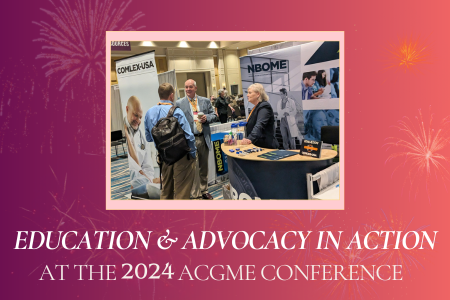
Advocacy in Action
Feedback from students, residents, advisors, program directors, and medical education leaders helps inform NBOME education and advocacy efforts. These insights guide outreach to residency programs and specialty organizations, help identify where additional resources or clarification may be needed, and support continued improvement in how osteopathic credentials are understood and used.
Student Feedback
Understanding Osteopathically Distinctive Assessments
News
Momentum Builds Across Surgical Specialties for COMLEX-USA Acceptance for DO Applicants
News
Pathology leaders urge for COMLEX-USA and USMLE Parity for Residency and Fellowship Applicants
News
New Study Demonstrates Positive Correlations between Performance on COMLEX-USA and Surgery In-service, Board Exams
News
Texas Medical Association Calls for Equivalent Recognition of COMLEX-USA and USMLE Exams in Residency Program Applications
News
Internal Medicine Leaders Join Growing Call for COMLEX-USA Equivalency in Residency Applications
News
Emergency Medicine Residency Leaders Call for COMLEX-USA Acceptance among Program Directors
News