
The National Board of Osteopathic Medical Examiners (NBOME) is proud to provide updates on the Core Competency Capstone for DOs (C3DO) and Comprehensive Competency Verification (CCV). Beginning with the Class of 2029, these pathways will offer osteopathic medical students two options to demonstrate competency in the clinical skills essential to osteopathic practice and required by the COMLEX-USA licensure examination program.
These two options, designed with input from across the osteopathic medical profession, assure assessment by direct observation of core osteopathic clinical skills in patient encounters as part of the licensure pathway for DOs, while minimizing the cost and travel requirements that were the principal criticisms of the former national clinical skills testing model for licensure. Both C3DO and CCV will be accepted for the clinical skills eligibility requirement for COMLEX-USA Level 3 and will be effective beginning with the Class of 2029.
At its Midyear Meeting in June, the NBOME Board of Directors approved prerequisites for C3DO and CCV, as well as the structure of the new CCV option, which will result in the achievement of a college of osteopathic medicine (COM)-based verification that a student has demonstrated competency in these essential skills.
Prerequisites for C3DO and CCV
Prior to participating in C3DO or completing the CCV protocol, the DO student must have:
- Taken and passed COMLEX-USA Level 1
- Completed four months (16 weeks) of core clinical clerkship/clinical education at their COM, including at least one primary care clinical rotation (e.g., family medicine, internal medicine)
- Six months or more of core clinical clerkship/clinical education is strongly recommended.
C3DO and CCV
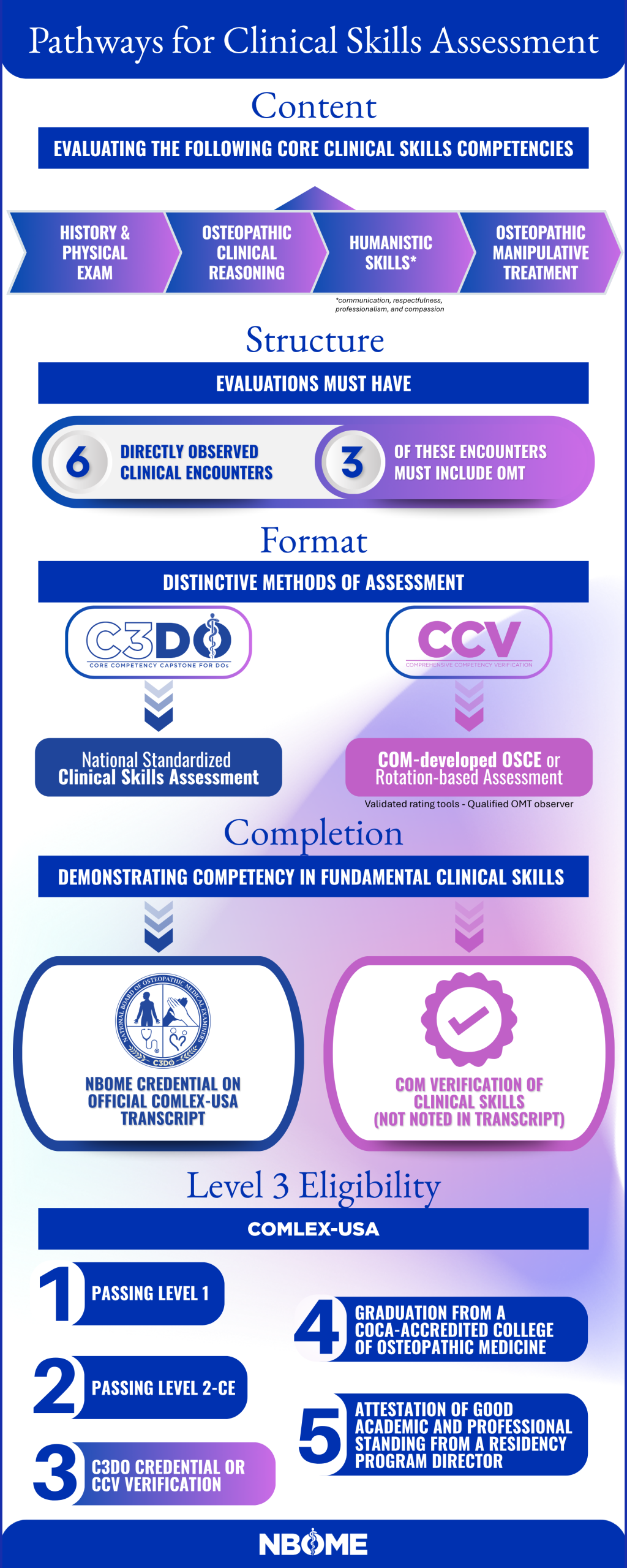
Aligned structure: To receive a C3DO credential from the NBOME or a CCV verification from their COM, the DO student must be assessed via six directly observed clinical encounters with different clinical presentations, including the following:
- The six patient encounters may occur either via the C3DO assessment, or COM-based Objective Structured Clinical Examination (OSCE)/rotation-based assessments using validated* rating tools and established rater training protocols
- At least three of the encounters must include evaluation of the performance of osteopathic manipulative treatment (OMT) on actual patients or standardized patients
- OMT must be evaluated by an observer qualified to evaluate OMT
*Validated tool describes an established assessment instrument (e.g., global rubric, checklists, coupled with rater training and quality assurance) that uses evidence-based research in medical education, training, and practice to accurately and reliably measure what is intended to be measured.
Aligned content: As part of both C3DO and CCV, the DO student is evaluated on:
- History building and hands-on physical examination skills
- Osteopathic clinical reasoning
- Interpersonal and communication skills, professionalism, and compassion in patient care
- Performance of OMT
Distinct formats: Completing C3DO or CCV
The C3DO is a standardized national assessment of osteopathic clinical skills administered at COMs that was developed by a collaborative process between the NBOME and the COMs, bringing together osteopathic medical educators, standardized patient and simulation experts, and assessment specialists.
The CCV is a COM-based verification process whereby each osteopathic medical student is directly observed in patient encounters and evaluated on the same skills assessed in C3DO, but with case materials and tools chosen by the COM.
Capturing osteopathic clinical skills competency for COMLEX-USA
When an osteopathic medical student successfully completes C3DO, they will receive a clinical skills credential reflected on their official NBOME/COMLEX-USA transcript, demonstrating that they have met a national standard. If their dean has verified successful completion of CCV, the student will receive a verification from their COM signifying they have met clinical skills competency via COM assessment. Both pathways will be acceptable as part of eligibility for Level 3 and will be documented in the NBOME Portal to verify the candidate’s qualifications and eligibility.
This dual-pathway structure ensures that all DO students are directly assessed on clinical skills competencies and have a defensible pathway available at their COM to satisfy the clinical skills requirement needed for COMLEX-USA Level 3 and licensure eligibility. These two different options also enable COMs to choose the assessment pathway that best aligns with their educational program, operational readiness, and existing assessment infrastructure while still satisfying accreditation, licensure and patient expectations.
NBOME President and CEO John R. Gimpel, DO, MEd
For more information about NBOME clinical skills assessment, including fees associated with C3DO and CCV, visit nbome.org/assessments/clinical-skills.