
Comprehensive Competency Verification (CCV)

About Comprehensive Competency Verification (CCV)
Build on your COM’s clinical skills assessment program. Document individual student assessment at the COM and achievement in a defensible manner through a standardized verification and documentation process.
The Comprehensive Competency Verification (CCV) pathway is designed for colleges of osteopathic medicine (COMs) that assess osteopathic clinical skills through their own institutional programs and want to continue using those programs for documenting individual assessment as an alternative to C3DO, meeting eligibility criteria for candidates to take COMLEX-USA Level 3 after graduation
What is the Comprehensive Competency Verification?
Your COM owns the assessment. CCV provides the COMs a means to document individual student assessment at the COM and achievement in a defensible manner through a standardized verification process.
With CCV, the COM retains ownership of how it assesses, evaluates, and remediates its students. Schools may utilize their existing clinical skills assessment infrastructure that meets the clinical skills requirement of COMLEX-USA rather than adopting a new assessment program. CCV provides the common framework for documenting that each student has been directly observed demonstrating the required osteopathic clinical skills.
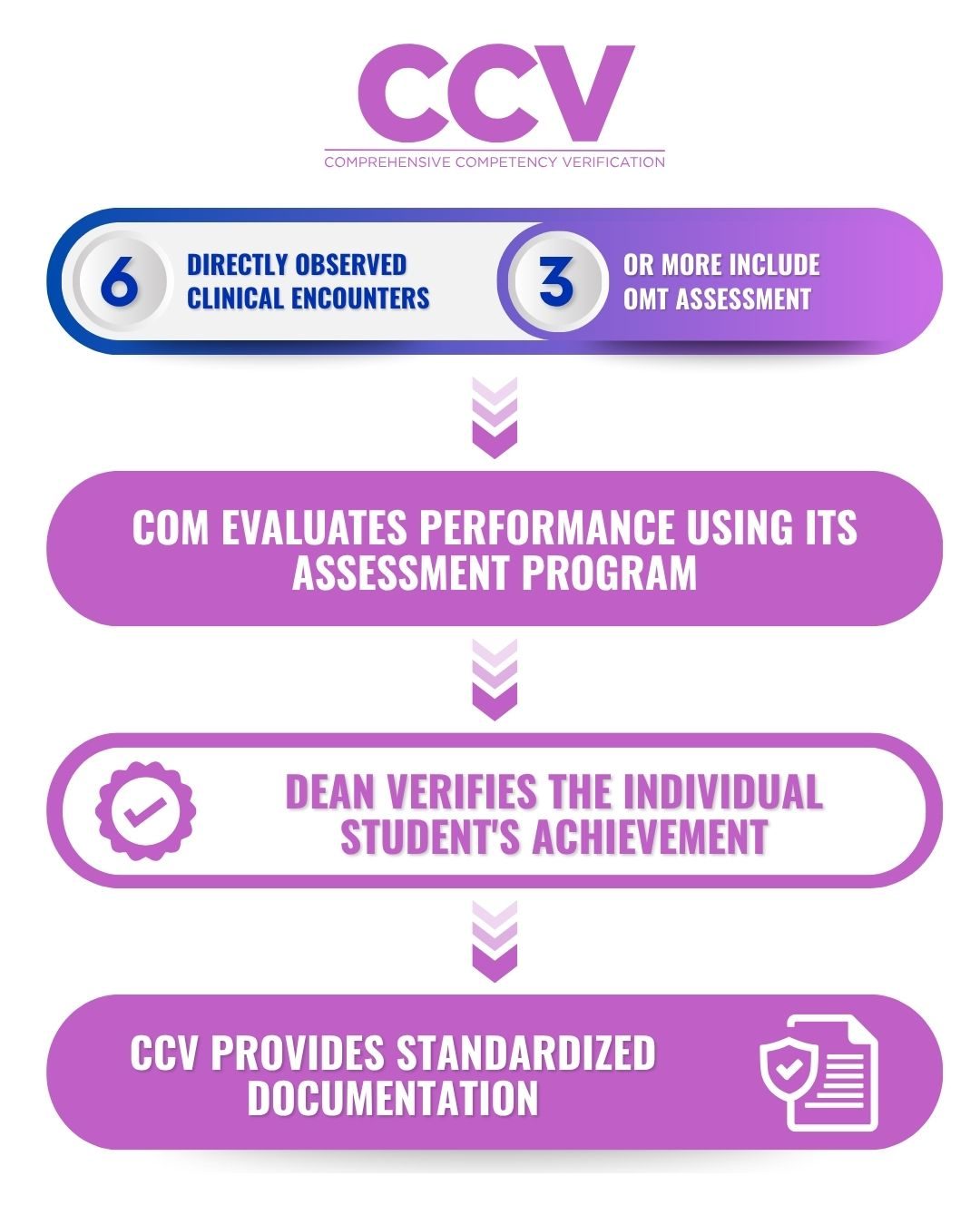
Each student must have documented evaluation through six different, directly observed patient encounters, including three encounters where OMT performance is assessed. The six different clinical presentations will be mapped to the NBOME Blueprint Clinical Presentations dimensions.
CCV therefore creates a consistent documentation and verification framework across participating COMs while preserving institutional flexibility in how individual student assessment is conducted.
The CCV verifies that a COM confirms that their student has been directly observed and assessed and judged to have met the following osteopathic clinical skills competencies at the level required for graduation:
- History building and hands-on physical examination skills
- Osteopathic clinical reasoning
- Interpersonal and communication skills, professionalism, and compassion in patient care
- Performance of osteopathic manipulative treatment
The CCV program:
- Supports documentation of clinical skills competency assessment for individual candidates as required for licensure (see COCA Standards Element 11.4)
- Provides access to a validated osteopathic clinical skills assessment tool reference library (in development)
- Provides access to assessment tools via mobile device for point-of-care evaluation of osteopathic clinical skills (in development, anticipate demo available April 2027)
- Delivers valuable reporting to COMs—including performance metrics, clinical presentation data, and comparative insights—to inform continuous improvement, research, and quality assurance.
Cost Structure
Student Registration: $275
Why Choose CCV?
CCV may be an appropriate pathway for a COM that:
- Already conducts defensible assessment that includes direct observation of students’ osteopathic clinical skills in the OMS 3-4 years and at the level required for graduation
- Has an established clinical skills assessment program it wishes to continue using
- Conducts appropriate individual student assessments through institutional clinical skills experiences, clinical rotations, or a combination of approaches
- Can document six qualifying encounters with different clinical presentations all consisting of direct observation for each student interacting with a patient (either standardized or in the clinical setting)
- Can include OMT assessment by qualified evaluators in at least three of those encounters
- Wants to preserve local responsibility for individual student assessment and verification while participating in a common documentation framework for students to demonstrate osteopathic clinical skills at the level required for graduation and as is required for candidates to meet eligibility criteria for taking COMLEX-USA Level 3
CCV Requirements
Assessment of the following osteopathic clinical skills:
- History building and hands-on physical examination skills
- Osteopathic clinical reasoning
- Interpersonal and communication skills, professionalism, and compassion in patient care
- Performance of osteopathic manipulative treatment (in at least 3 encounters)
The DO student must complete six directly observed clinical encounters with different clinical presentations:
- Encounters may occur via COM-developed Objective Structured Clinical Examination (OSCE) with standardized patients, clinical rotation-based assessment using validated* rating tools and established rater training protocols, or a combination of the two (e.g., three station OSCE plus three clinical rotation-based assessments)
- At least three encounters must include the evaluation of the performance of OMT on actual patients or standardized patients (by qualified OMT evaluator)
*Validated tool describes an established assessment instrument (e.g., global rubric, checklists, coupled with rater training and quality assurance) that uses evidence-based research in medical education, training, and practice to accurately and reliably measure what is intended to be measured. Examples include Kalamazoo, Mini CEX.
Student Eligibility
Prior to completing the CCV protocol, the DO student must have:
- Taken and passed COMLEX-USA Level 1.
- Completed 4 months (16 weeks) of core clinical clerkship/clinical education, including at least one primary care clinical rotation in family medicine and/or internal medicine.
- Six months of clinical education is strongly recommended.
Once a student has received the six evaluations via OSCE and/or clinical rotation-based assessment, their COM dean will verify successful completion. Students who receive a CCV from their dean will have that noted in their NBOME account as meeting part of the eligibility criteria to take COMLEX-USA Level 3. COMs electing to utilize CCV will be able to track student progress in the NBOME Learning Center.
Note: While CCV parallels the C3DO assessment in terms of skills measured, participating students will not earn the C3DO credential noted on their NBOME transcript.
Your assessment program.
A standardized verification framework of individual student assessment.
CCV is not an NBOME-administered examination and is not intended to replace a COM’s clinical skills assessment program. Instead, it provides a common approach for defensible documentation of the results of the COM’s assessment of each student’s osteopathic clinical skills.
| The COM Determines | CCV Standardizes |
| How clinical skills education is delivered/assessed | Documentation of the required directly observed clinical encounters |
| How the institution structures its assessments | Documentation that six different encounters have been completed and that three encounters include assessment of OMT. The 6 different diagnoses can be mapped to the NBOME Blueprint Clinical Presentations. |
| Whether qualifying observations occur through the COM’s assessment program (OSCE or capstone) or in clinical rotation settings | A consistent documentation framework across participating COMs. |
| The institution’s evaluation and verification decisions | Verification of required clinical skills assessment for each student by the COM Dean. |
CCV versus C3DO:
Two different approaches to document individual clinical skills assessment
Both pathways preserve direct observation of osteopathic clinical skills, but they generate evidence differently. C3DO provides a standardized national assessment process. CCV enables a COM to generate the evidence through its own institutional assessment program and then document each student’s assessment and achievement through a common CCV framework.
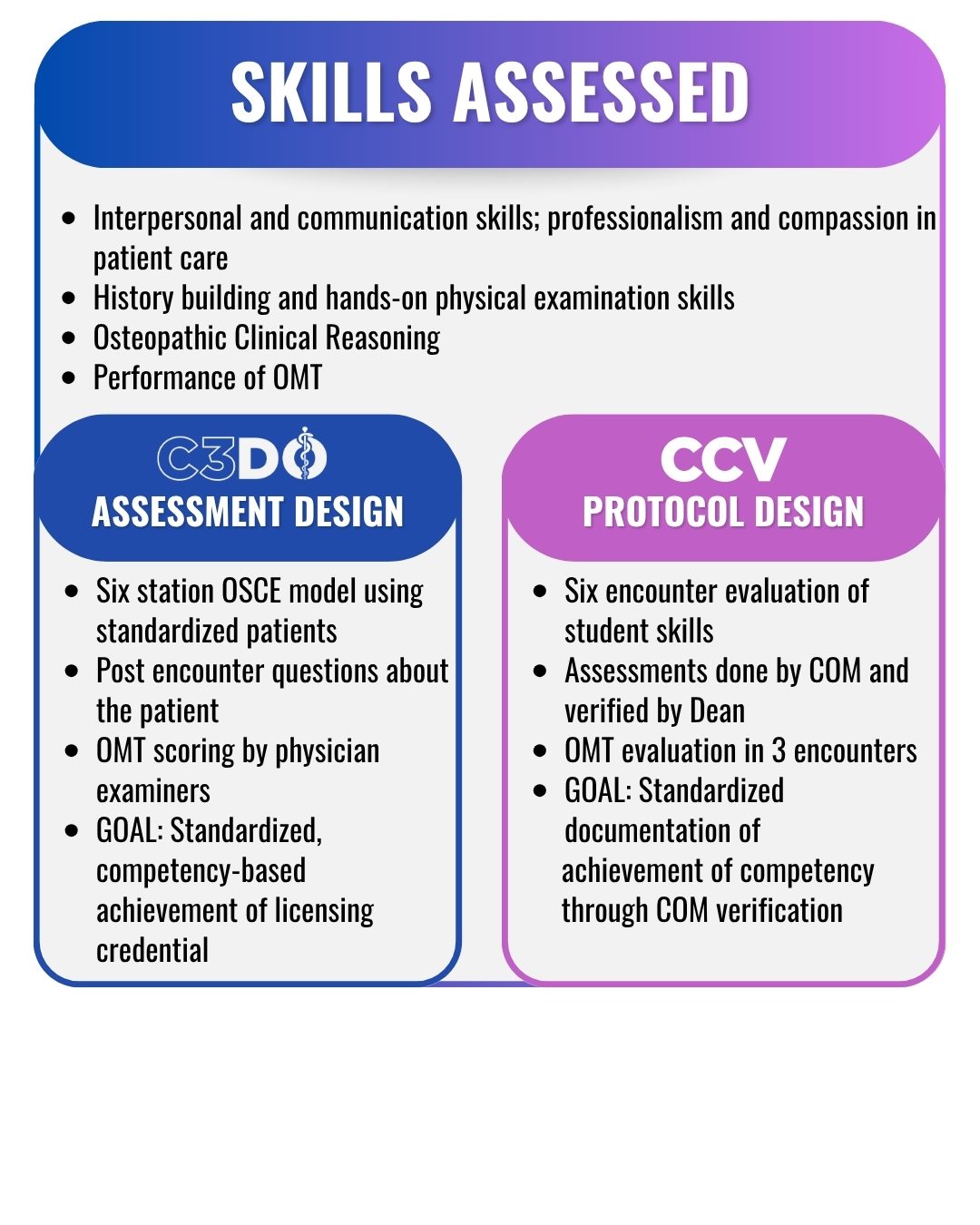
For a COM with an established clinical skills assessment program, CCV offers the opportunity to build on existing educational and assessment infrastructure while providing standardized documentation of each student’s demonstrated clinical skills.
CCV does not require your COM to replace its established assessment program.
What CCV does not prescribe:
- The NBOME does not provide clinical cases, assessment structure or standards; verification and successful completion decisions reside with the school/dean.
- COMs maintain responsibility for the clinical assessment experiences they use.
- The NBOME does not prescribe specific evaluator training for CCV or evaluate the COM’s program processes. When using standardized patients or other evaluators, COMs should follow national guidelines established by organizations such as the Association for Standardized Patient Educators, the Directors for Clinical Skills Courses, or the Society for Simulation in Healthcare. OMT performance with standardized patients or on actual patients on clinical rotations should be evaluated by an osteopathic physician or an MD who has undergone training and certification in OMT.

Frequently Asked Questions
We’ve compiled answers to some of the most commonly asked questions about the NBOME, our products, and services. If you can’t find the information you’re looking for, please feel free to reach out to us.