Starting with the graduating class of 2029, the NBOME will make new options available for assessment and verification of osteopathic clinical skills competencies as part of the eligibility requirements for COMLEX-USA Level 3. These will both require the demonstration that a candidate possesses fundamental osteopathic clinical skills competencies at the level expected for entering graduate medical education.
Eligibility for COMLEX-USA Level 3 will require:
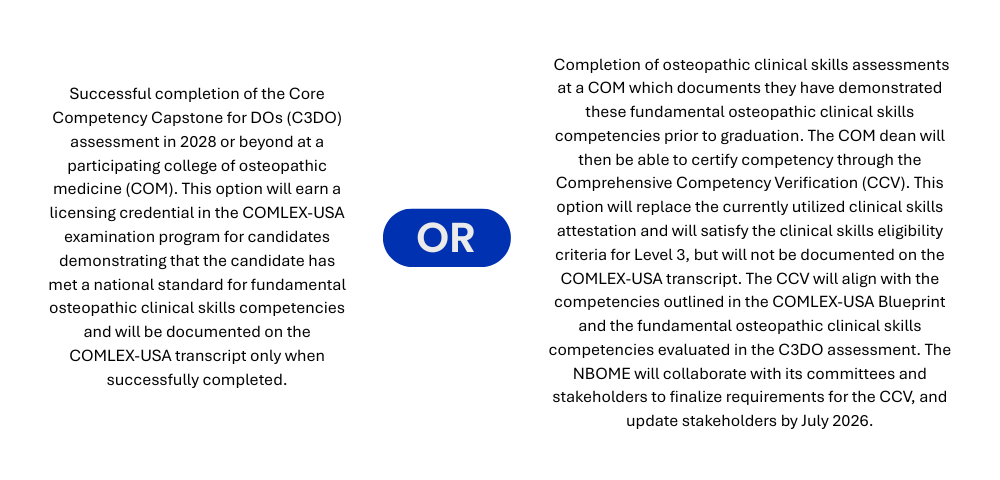
Additional evidence for the validity and reliability of these options will be gathered on an ongoing basis. The NBOME Board anticipates that the C3DO assessment will be the standard for Level 3 eligibility in the future.
For the graduating classes of 2026-2028, the current model of attestation of osteopathic clinical skills competencies will remain in place. This extends the current attestation model through the class of 2028, after which time it will sunset, replaced by one of the options above.
The Board remains committed to being mindful of minimizing fees incurred by students and costs for COMs and plans to continue delivering the NBOME portion of the C3DO assessment through 2027 without fees to students or COMs. Aligned with this intention to minimize student costs, COMLEX-USA fees for Level 1 and Level 2-CE will remain the same, with no fee increases in the 2026-2027 test cycles. COMLEX-USA Level 3 will also transition from its current 2-day administration to a 1-day format in 2027.
C3DO provides an assessment of the following osteopathic clinical skills competencies to a national standard:
- history-building and physical examination
- performance of osteopathic manipulative treatment (OMT)
- clinical reasoning
- humanistic skills of communication, respectfulness, professionalism, compassion, and cultural humility
These are evaluated through participation in a multi-station, modified Objective Structured Clinical Examination (OSCE) standardized patient-based assessment. It utilizes standardized assessment tools and training protocols, osteopathic physician examiners, and a national case bank aligned with the COMLEX-USA Blueprint. Innovative use of artificial intelligence, technologies, and principles of competency-based medical education will continue to be explored as the C3DO assessment further evolves.
The decision to utilize C3DO as a licensing credential came after a thorough review of data and other outputs from Phase 1 and Phase 2 of the C3DO pilots. This work commenced following recommendations of the Special Commission on Osteopathic Medical Licensure Assessment in 2022.
The C3DO initiative has included more than four years of collaboration and feedback from key stakeholders, including the C3DO Task Force and Advisory Panel, state licensing boards, patient safety advocates, representatives from 35 COMs, 15 COM campuses delivering C3DO and their students, NBOME Liaison Committee organization members, specialty societies and councils, and student and resident organizations.
The NBOME would like to thank the organizations involved with osteopathic medical professional self-regulation, particularly the American Osteopathic Association, the Commission on Osteopathic College Accreditation, the American Society of Osteopathic Medical Regulators, and the American Association of Colleges of Osteopathic Medicine, as well as the Educational Council on Osteopathic Principles, for their continued guidance and input.
Please visit the updated C3DO page for information about the C3DO assessment program. An updated list of Frequently Asked Questions will be available in July 2025.