
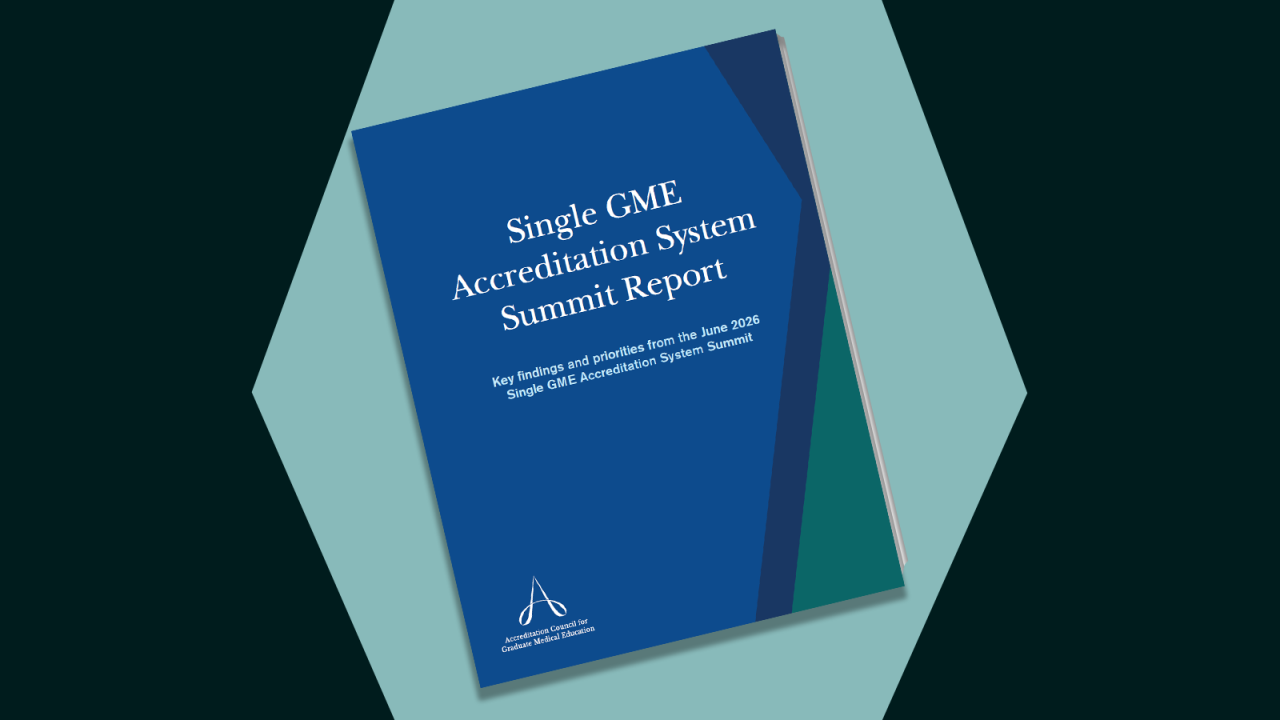
According to a recently released report from the Single GME Accreditation System Summit, leaders from across medical education are calling for action to universally accept degree-specific assessments—therefore removing the dual COMLEX-USA/USMLE examination burden—and to also eliminate differential clinical rotation fees and other barriers facing osteopathic medical students.
Convened by the Accreditation Council for Graduate Medical Education (ACGME), the Summit brought together undergraduate and graduate medical education leaders, specialty organizations, residency programs, and national partners from across the house of medicine to assess progress and identify priorities.
At the Summit, the NBOME was represented by President and CEO John R. Gimpel, DO, MEd; Chief Assessment Officer Gretta A. Gross, DO, MEd; and Board Chair David Kuo, DO. The American Osteopathic Association (AOA) and American Association of Colleges of Osteopathic Medicine (AACOM) also participated and provided important perspectives to open the summit.
All osteopathic medical (DO) students take COMLEX-USA, which is accepted for licensure in all 50 states and several international jurisdictions. Yet 40–60 percent of DO students in recent years have also elected to take one or more USMLE examination in addition because of perceived expectations or requirements in residency selection.
Summit participants agreed that requiring DO students to take USMLE must not continue and identified two immediate and correctable priorities for action:
- Eliminate the dual COMLEX-USA/USMLE examination burden through universal acceptance of degree specific assessments; and
- Eliminate differential fees or barriers for osteopathic medical students in clinical rotations
Per the report: “Universal acceptance of degree specific assessments is a foundational step toward the parity the transition to a single GME accreditation system was designed to deliver. Summit participants reached clear consensus that requiring osteopathic medical students to take both the COMLEX-USA and USMLE must not continue.”
The report recommends “joint guidance affirming COMLEX-USA and USMLE as equivalent, valid pathways for residency application;” evidence-based guidance for interpreting licensing examination performance; and expanded education and outreach to residency program directors and coordinators.
“More than ten years into a single accreditation system, our shared responsibility is to ensure that progress in structure translates into equal opportunity for DO and MD applicants in GME,” said Gimpel. “Clarifying that COMLEX-USA is used for DO applicants equivalently to how the USMLE is used for MD applicants in all programs and specialties is now an immediate priority for the ACGME and the entire house of medicine, not just the AOA, AACOM, and NBOME. Doing so bodes well for fairness, inclusion and for the patients we serve.”
The report recommendations align with ongoing NBOME efforts to support appropriate use of COMLEX-USA through research, education, and collaboration with residency programs, specialty organizations, and national partners. These efforts over more than 10 years aim to reduce unnecessary barriers for DO applicants and advance the parity envisioned under the Single GME Accreditation System.